
Grille – 2016 Toyota Prius 5dr HB Three Touring (Natl)
Enlarge Photo
Toyota has long been the laggard on battery-electric cars, claiming they’re only suitable for shorter trips and promoting hydrogen fuel cells as the best zero-emission vehicle technology.
Pushed by China and its increasingly tough emission rules, the company reluctantly committed to building all-electric cars by 2020.
Now a report suggests that the company’s electric-car ambitions are increasing.
DON’T MISS: Shift to electric cars will cost money, may lack excitement: Toyota CEO
The Chunichi Shimbun, a Japanese newspaper, reports (via Reuters) Toyota is developing solid-state batteries for its future electric cars.
The first vehicles to house that next-generation technology, it says, will go on sale early in 2022.
That’s likely right around the time that a fifth-generation Prius would be released, potentially offering Toyota opportunities for joint development of its new electric car alongside its iconic hybrid.
Late last year, Japan’s Nikkei newspaper said Toyota would build and sell its first long-range electric car by 2020.
The importance of the effort may be indicated by reports that namesake and CEO Akio Toyoda would head the team developing the new electric model.
Every battery company is now investing major funds in both lithium-ion cell advances and research into next-generation technologies.
READ THIS: Why Toyota’s ‘agonizing’ U-turn toward electric cars? Because China says so
If the reports are accurate, Toyota’s use of solid-state cells could conceivably be a first for any large global carmaker.
Claims that the upcoming Fisker Emotion luxury electric sedan would use a solid-state battery were superseded by reality this week, as the company announced it had parted ways with the startup company Nanotech, which was to supply the cells.
According to report from Chunichi Shimbun, Toyota’s solid-state batteries will offer greater range than current lithium-ion batteries and, crucially, a recharge time of only a few minutes.
As the name suggests, solid-state battery cells use a solid electrolyte rather than the liquid used in most lithium-ion cells today.
The claimed benefit of solid-state batteries is that they’re less prone to overheating or fire, and their energy density is much higher, meaning longer-range electric cars with smaller, lighter battery packs.
Today, however, solid-state cells remain extremely expensive to fabricate on a mass scale. That’s the arena in which dozens of companies are collectively pouring billions of dollars of research and development funding.
CHECK OUT: Toyota to offer electric car in 2020 as fuel-cell sales struggle
Toyota began research on its hydrogen fuel-cell technology at the same time it launched the Prius hybrid team in the early 1990s.
Its Mirai, now on sale globally for more than two years, has struggled to win sales amid a slower-than-expected rollout of the hydrogen fueling-station network required to operate the cars.
While the company partnered with Tesla to design the 2012 Toyota RAV4 EV, that was strictly a compliance car to meet a part of California’s 2012-2017 zero-emission vehicle rules, and only about 2,500 copies were built.
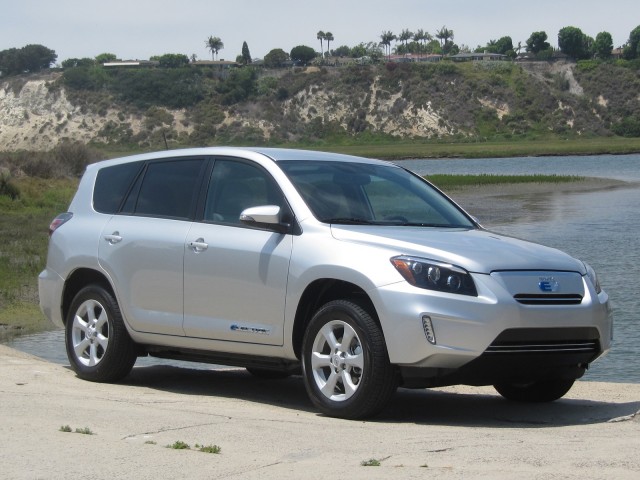
2012 Toyota RAV4 EV, Newport Beach, California, July 2012
Enlarge Photo
Toyota has a mixed track record in battery development: its partnership with Panasonic to produce nickel-metal-hydride cells for something like 7 million hybrid vehicles has proven that technology to be robust, durable, and inexpensive.
The third-generation Prius, launched in 2010, was to have migrated to a lithium-ion battery, however, but Toyota chose the wrong cell chemistry, it later admitted, and was forced to continue with the older, heavier batteries throughout that car’s life.
During a 2010 technical presentation by Toyota’s managing officer Koei Saga, he said the lithium cell that was to have been used in the 2010 Prius used a nickel-based chemistry that turned out to have low materials costs but a much more complicated production process.
That made its overall cost too high, and for the production 2012 Toyota Prius Plug-In Hybrid, the company was forced to switch to a less expensive “tri-metal” electrode that combined cobalt, nickel, and manganese.
_______________________________________
Follow GreenCarReports on Facebook and Twitter.