
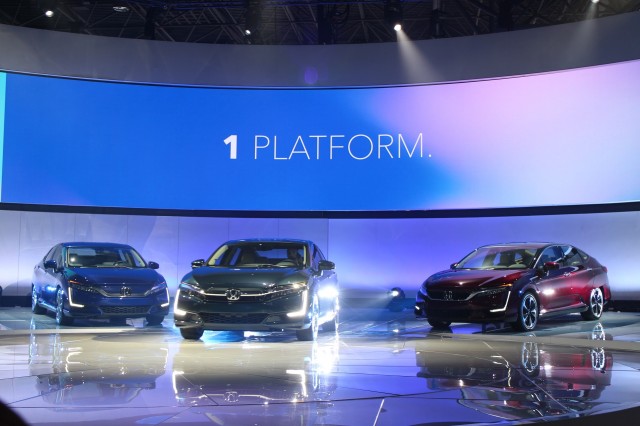
Honda Clarity lineup: Electric, Plug-In Hybrid, Fuel Cell, at 2017 New York auto show
Enlarge Photo
The 2017 Honda Clarity Fuel Cell is the only model presently on sale, though the all-electric version will arrive later this year.
The hydrogen-powered mid-size sedan with a rated 366 miles of range is the one that’s gotten by far the most publicity from Honda, as its technology halo vehicle.
Last month, at the New York auto show, Honda unveiled both the all-electric and plug-in hybrid versions that round out the lineup.
DON’T MISS: Honda Clarity Electric, Plug-In Hybrid revealed at NY auto show
That leads to a handful of questions about how the three different models fit into Honda’s plans, and how the company plans to promote and market them—and in what volumes.
To answer some of these questions, we spent an hour at the show talking to Jay Guzowski, the senior manager of product planning for the Clarity range.
We started by asking how the decision to develop the Clarity was made and what parameters the company placed on its future product.
In particular, we were curious about the roughly 80-mile range rating Honda projects for the Clarity Electric, which uses what is obviously a fairly small lithium-ion battery pack.
Guzowski said that the Clarity project started as three separate green vehicles were ending: the previous-generation FCX Clarity fuel-cell sedan, the Accord Plug-In Hybrid, and the Fit EV electric car.
All were low-volume: about 200 FCX Claritys were built globally, and 1,000 and 1,100 of each of the last two were delivered in the U.S. (Some of the Fit EVs have now been re-leased as used cars and are still on the road.)
A MUST-READ: 2017 Honda Clarity Fuel Cell: first drive of hydrogen-powered sedan
To maximize the effectiveness of its investments, Honda chose to combine successors to all three vehicles into a single vehicle—although, Guzowski said, it was clear that the hydrogen fuel-cell version was viewed in Japan as the most important and most visible of the three versions.
The FCX Clarity and the plug-in Accord had been large, comfortable, mid-size sedans. The major complaint from Fit EV owners, meanwhile, was that they loved their cars but wished they were larger and had more space for people and cargo.
That set the basic size and body type of what came to be called the 2017 Honda Clarity.
A green five-passenger vehicle with multiple powertrain options, Guzowski pointed out, was largely “white space” when the program began in 2012 and 2013.
The only other such vehicle, the all-electric Tesla Model S hatchback sedan, had just entered the market. At that time, we’d note, its success and sales of well over 100,000 vehicles were by no means guaranteed.
The hydrogen Clarity would let Honda meet its commitments to the Japanese government’s “hydrogen economy” program, he said, and was always earmarked to be sold both in Japan and the U.S.
CHECK OUT: Honda Clarity EV electric car to have only 80 miles of range: report
Japanese product planners were also interested in the plug-in hybrid model—envisioned as a much higher-volume variant.
But the all-electric version was “not of high interest” to the Japanese planners, Guzowski recounted, noting that the company saw electric cars suffering from “challenges with the grid and reliability” of charging infrastructure.
The Clarity program solidified in 2014, with the fuel-cell version “leading a little” because it had the toughest packaging challenges.