
Large global automakers customarily pursue research into multiple types of technologies and future powertrains at the same time.
Sometimes they pan out, sometimes they don’t.
German automakers have only really come around to devoting their efforts to plug-in electric cars in the last five or six years.
DON’T MISS: Mercedes-Benz electric cars to arrive sooner as urgency increases
Before that, zero-emission vehicles of the future were expected to operate on hydrogen fuel cells, for which networks of fueling stations to supply pure hydrogen at high pressures would have to be constructed.
Mercedes-Benz parent company Daimler was one of the earlier companies to commit to research on vehicles powered by hydrogen.
In 2013, it partnered with Ford and Nissan in a three-way R&D development group to pool hydrogen fuel-cell technologies and share the high costs of getting such vehicles into production.
Part of that announcement included a delay in the first “volume” production Mercedes powered by a fuel cell, from 2015 to 2017.
Last year, the company unveiled an adapted GLC crossover utility that used not only a hydrogen fuel cell to power its electric drive motor but also included a 9-kilowatt-hour plug-in battery pack large enough to carry the car for 20 miles or more on grid electricity alone.
You could think of it as a plug-in hybrid whose range extender was a hydrogen fuel cell rather than a gasoline combustion engine, if you like.
READ THIS: Mercedes-Benz GLC to offer world’s first plug-in fuel-cell powertrain
Within the last week, however, Mercedes said it will speed up the deployment of its planned battery-electric vehicle lineup, advancing it as much as three years from 2025 to 2022.
And last summer, David Wenger—a German hydrogen proponent and driver of a Mercedes-Benz B-Class F-Cell, the small Mercedes hatchback powered by a hydrogen fuel cell—shared his experiences with the trade outlet H2-International.
“In total, the results are sobering, sadly,” he said. “That really hurts.”
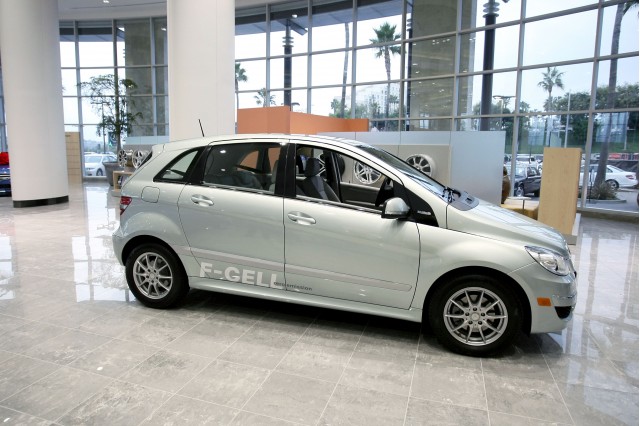
First Mercedes-Benz B-Class F-Cell hydrogen fuel-cell vehicle delivery, Newport Beach, Dec 2010
Enlarge Photo
Among the challenges were the car’s short range between refueling stops, compared to diesel versions of the same B-Class, and questionable reliability of the fueling network—even with a phone app that was supposed to show real-time status of each station.
Now it appears that Mercedes is being more publicly negative about the prospects for future cars powered by hydrogen.
As noted in a recent article by Gas2, Daimler CEO Dieter Zetsche said last week at an industry conference that fuel cells would no longer be a part of the company’s near-term roadmap for volume vehicles.
CHECK OUT: Early Mercedes fuel-cell driver’s ‘sobering assessment’ to industry
“Battery costs are declining rapidly whereas hydrogen production remains very costly,” Zetsche is quoted as saying.
The planned GLC F-Cell plug-in fuel-cell crossover will go ahead, he suggested, but be reserved to fleet operators only—those who had centralized hydrogen fueling capabilities themselves.
While fuel-cell vehicles remain “technically interesting,” Zetsche continued, they will not be practical for consumer sale until the price of hydrogen fuel falls considerably after widespread and cheap renewable energy becomes available.
And there you have it.
[hat tip: m2cts]
_______________________________________
Follow GreenCarReports on Facebook and Twitter.