Valtteri Bottas waits out a brief rain shower at the inaugural Miami Grand Prix, May 8, 2022. He goes on to finish seventh, after Verstappen and Perez’s pair of Red Bulls, the Ferraris of Leclerc and Sainz, and a Mercedes duo of Russell and Hamilton.
It’s the biggest racing series on the planet, with a global TV audience that accounts for about a quarter of the people on earth. It’s booming in the U.S. thanks to streaming docudrama. Formula 1 long ago outgrew its European roots. Now it’s a phenomenon.
And until now, I confess, I didn’t love Formula 1.
I’ve been to F1 races, of course. I moved to Detroit during its woeful GP run. I’ve seen Hamilton fly through a chicane four dozen times in Montreal and overtake on the first lap. But I haven’t followed it with enthusiasm.
I need less time gauging infotainment systems and third-row seats, I’ve decided. I need to love Formula 1.
I don’t want to learn it from car people, though. To avoid that, I turned to an expert and superfan. I turned to my niece. Megan is almost 32, a South Floridian for a decade now, still the little girl who I held the hour she was born, who asked her grandmother to play Annie Lennox in the car on the way to school.
She’s the biggest Formula 1 fan I know—and, it turns out, kind of a demanding schoolmaster. My first assignment: watch everything. But first, some backstory.
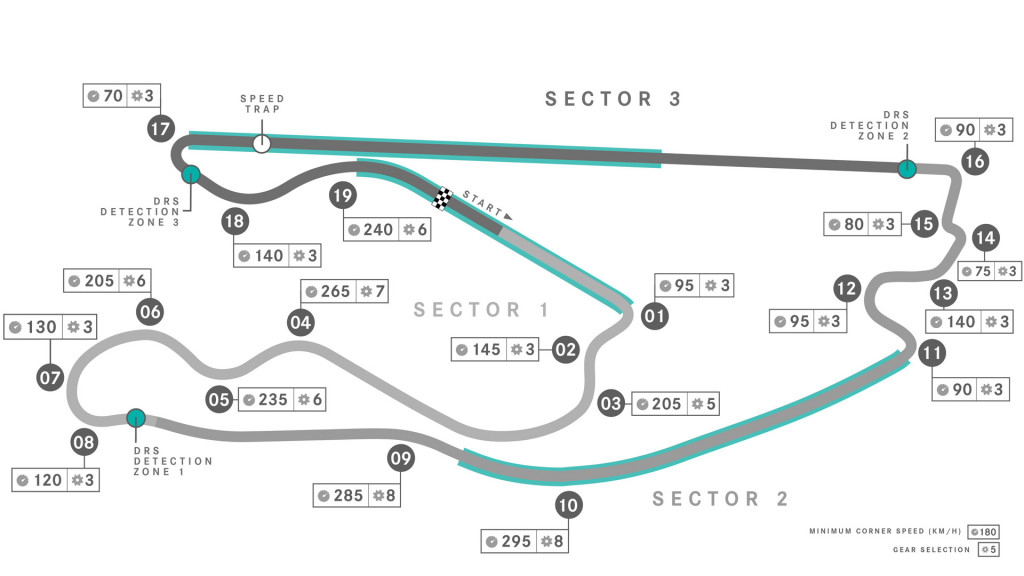
The Miami Grand Prix track layout wraps around Hard Rock Stadium, swallowing parking areas and providing little elevation change. Despite lots of effort at paving it with heat-worthy material, drivers say the surface limits passing—it’s too slick off the established racing line.
How the Grand Prix came to Miami
In its epic history, Formula 1 has tried in vain many times to conquer America, and failed often. F1 has tried out dozens of sites in the U.S. from long-forgotten races in Savannah to legendary battles at Watkins Glen, from the Detroit street races that Ayrton Senna cursed as bumpy and rough to a dismal reign in Phoenix before the series went dark stateside for a while. When it relaunched in the U.S. in Austin, Texas, in 2012, it finally had the right pieces in place, first among them a beautifully designed track with ample room for everything and everyone.
All it needed was better storytelling. It got that in 2017 when Liberty Media acquired the series for $4.4 billion, with the concrete goal of amassing a bigger American audience. It lifted the ban on drivers posting to social media first; then it created “Drive to Survive,” a Netflix series that follows the F1 circuit in narrative form. When Covid hit, it created the perfect moment storm for binge-watchers soaking up character-driven drama that hadn’t been strip-mined for streaming or theaters like a Disney property.
It’s no surprise that Megan is a massive Disney fan. “You get to experience all these different things from the world,” she says. “To have Formula 1 in Miami, I mean, in theory I could in the same week do two of my favorite things.”
She credits Disney friends who live in the Orlando area with turning her on to the races. On weekend visits she’d wake up last to racing on TV on Sunday morning, a taste friends Abby and Tom had acquired.

2022 Miami Grand Prix
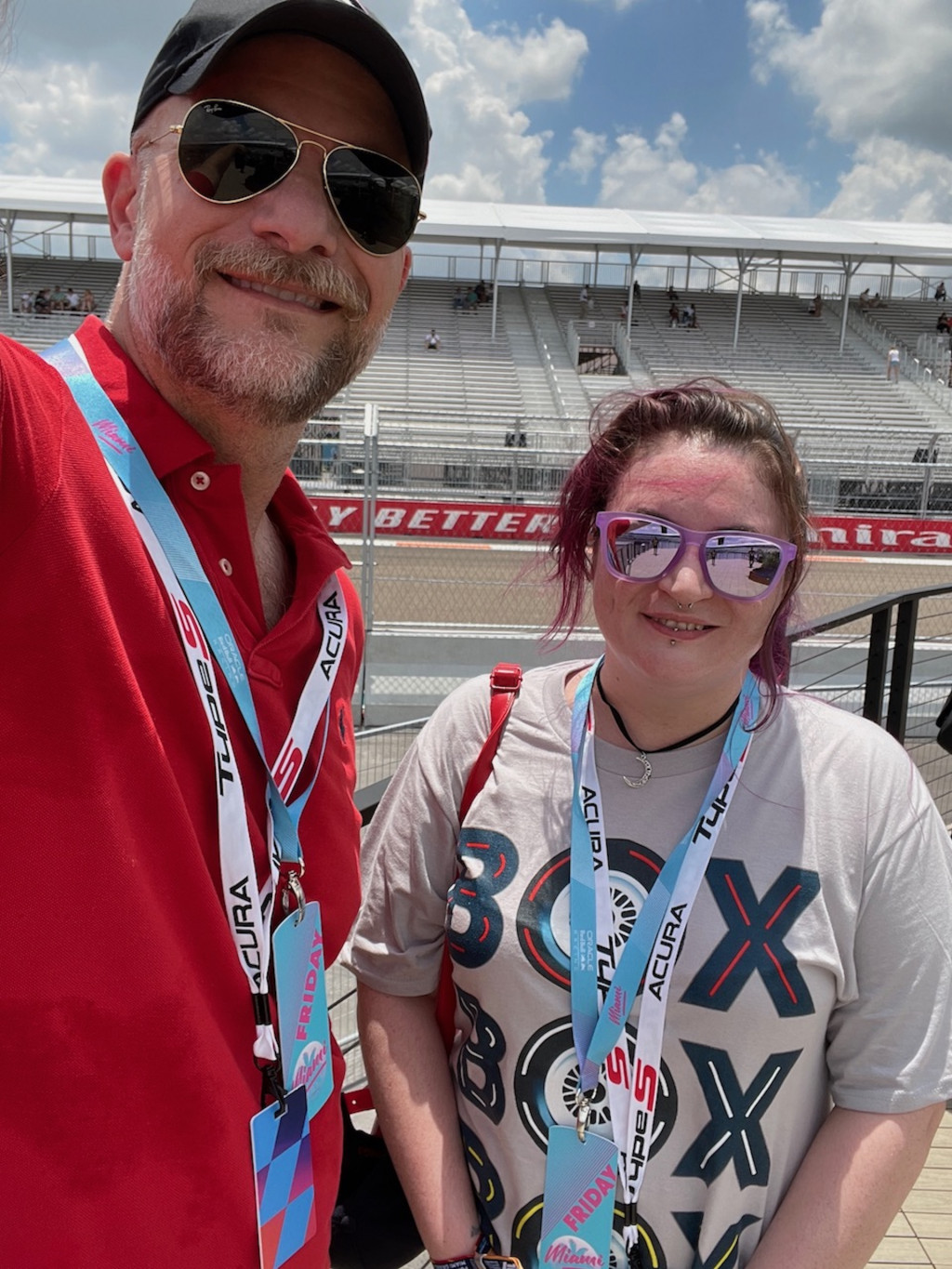
Megan’s T-shirt got lots of approving nods during the Miami Grand Prix.

2022 Miami Grand Prix
“I was like, all right, what time are we waking up for the race?” she says. “What time does it start?”
Two years later, she’s become a major Max Verstappen fan, clinging to him as she’s done with Stitch, Beast, and a whole host of other Disney characters we’ve both paid to fuel her habit. How she got there wasn’t convoluted: “It could have been something as simple as my brain being like, we like Red Bull.”
I remind her that I vividly remember her opening a Red Bull on a trip somewhere else in Florida. I asked, “why does it smell like Sweet Tarts and death in here?”
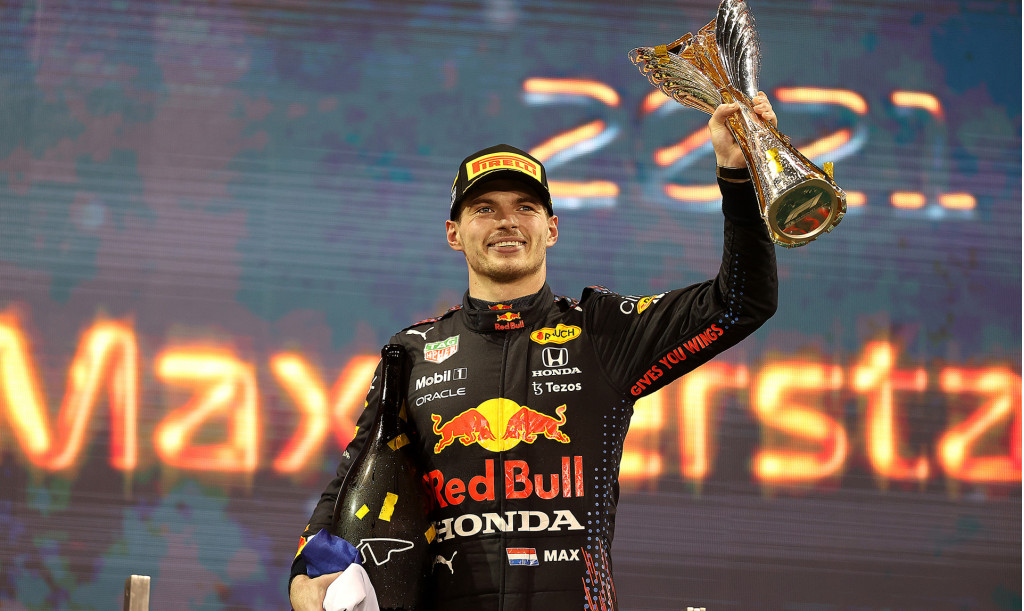
Red Bull Racing’s Max Verstappen at the 2021 Formula One Abu Dhabi Grand Prix
“Sugar-free Red Bull,” she lights up. “Yeah, I just was like, oh, that’s a cool-looking car. Who’s this guy? Number 33. Okay. I like odd numbers. Okay. Let’s go, go, go.
“It was the perfect choice because I love people that are always pushing and showing emotions,” she explains. “People say that he’s a whiner, people say he’s a jerk…but I think that’s just straightforward.”
A few races later, she recalls, she was laying in bed watching Max take first place. “‘We’re taking this no question,’” she recalls. “And down the long straight around back he gets a puncture and is out of the race. [I] jumped up on the bed, standing on the bed, screaming.
“Dan was like, ‘please calm down, it’s eight in the morning. You’re scaring the cats.’ I think that might have been the click where I was fully into it.” When Max cried after he’d won the F1 driver’s championship last year, Megan cried too.
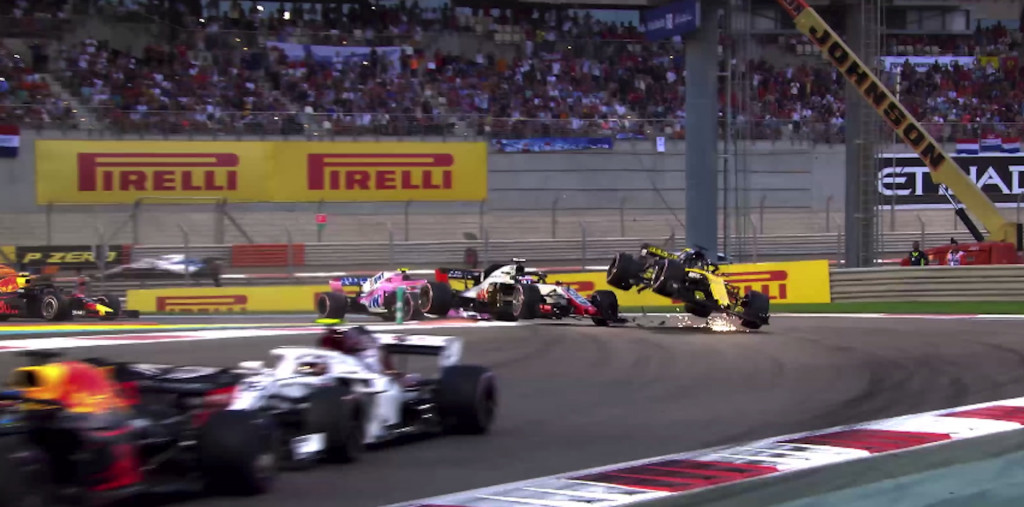
‘Formula 1: Drive to Survive’ trailer
Practice laps: “Drive To Survive”
Megan says the only way for me to get into F1 in the few short weeks before we’ll meet in Miami is via Netflix and “Drive to Survive.”
However you think it affects the racing series and its prestige, it’s impossible to deny that with “DTS,” Liberty Media has carved off a serialized, streaming-friendly narrative slice of F1. It’s not unlike one of my favorite shows, “RuPaul’s Drag Race,” with its multifarious challenges, fan favorites and hated characters, and an unspoken backdrop of money. If you have it, you’ll do better than if you don’t. Liberty’s moderate investment in connecting the media dots has blown up U.S. audiences for each race by more than 50 percent.
I shotgun the fourth series over two nights. From the “Clash of the Titans” title card in Episode One, I realize clichés are the engine that drives “DTS,” right up there with half-lit profile shots of talking heads. Part Olympian battle, part corporate sizzle reel, it’s a show about what F1 thinks of itself—sleek, global, and heroic (but more on that later).
I see tracks I’ve driven for work—Catalunya and Austin. But I’m confused often in the early episodes, as characters get established as drivers and as people in a parade of young, ripped physiques. Call it Twink TV, like a bad Fort Lauderdale local-cable show. When Hamilton complains about the “new kids that are coming up” I think he’s talking about himself then recoil in horror when I realize he’s not 28, but 37.
There’s artifice, for sure, as people say things to each other that would be parenthetical. But the reality piece pierces the high-sheen veil early, and often. Most drivers wear Covid masks, and so do most teams. There are no women drivers, and no women who own teams, though there have been women who ran teams. Awkwardness is reality, and it can cut through the incredible camerawork and expert editing. (The whole show looks so expensively produced, there should be a dollar/Euro ticker spinning in the lower right corner.)
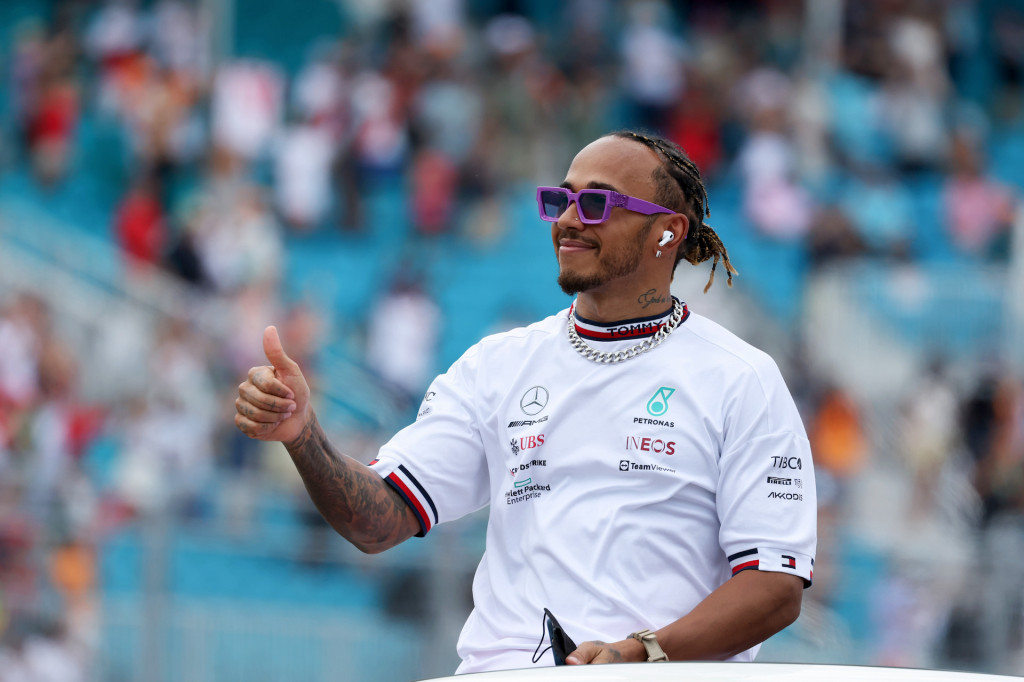
Lewis Hamilton at the 2022 Miami Grand Prix.
Netflix staggers episodes to cast as a series of battles, and Episode One is mostly about Hamilton, the politically driven seven-time champion who’s more than a driver—he’s a brand, a media universe of his own, and still, a firebrand. I’ve seen Hamilton race once before, in Montreal, and the guy can alter time and clearly has the motor skills and neural processing power of an F1 driver from 3022. Contrast with Max Verstappen’s first pole position the season after his first driver’s championship—the first time that didn’t go to Hamilton since 2016—and Verstappen getting a villain edit like “Survivor” or “RuPaul’s Drag Race.”
As episodes roll and build up pace, the other dramas that orbit around the series as if around a sun gear take the stage: Mick Schumacher’s unstated mission to follow in lockstep with his father; Jost Capito’s quixotic effort to turn around the Grey Gardens of Formula 1, Williams; AlphaTauri’s foul-mouthed rising Japanese star, Yuki Tsunoda, properly product-placed in an NSX; Ricciardo’s troubles at McLaren and his utter relatability (“I’m going to eat a fuck ton of pizza tonight”).
There are villain edits, then there are edits in which you’d expect characters to eat a live baby on screen. Nikita Mazepin starts with a “my dad owns a car dealership” vibe, and goes off-road so often he should be driving for Land Rover. His scenes read darkly now, of course, given the ouster of Russian drivers from this year’s schedule.
I admit to myself, I’d probably be a Valtteri Bottas fan. He takes on-camera humiliation with classic Finnish reserve—he turns a bit red during his awkward departure glass of water with Benz team chief Toto Wolff. For a Finn, that’s practically flipping tables in anger.
By the end of the fourth season I begin to understand the minutiae of what can go right, and then everything else. A machined nut drops Bottas out of contention; a gearbox takes out Ferrari. All of it takes place amid staged scenes in which team owners climb mountains, play hockey, and reveal their backstories in a way that’s both artificial and telling. Every other sports league could learn from it—and probably is already planning on a knock-off if they don’t have one already. “DTS” renders Formula 1 digestible through its familiar fable-like story lines. It’s a collection of mini-sagas, with enough pedestals to go around for everyone.
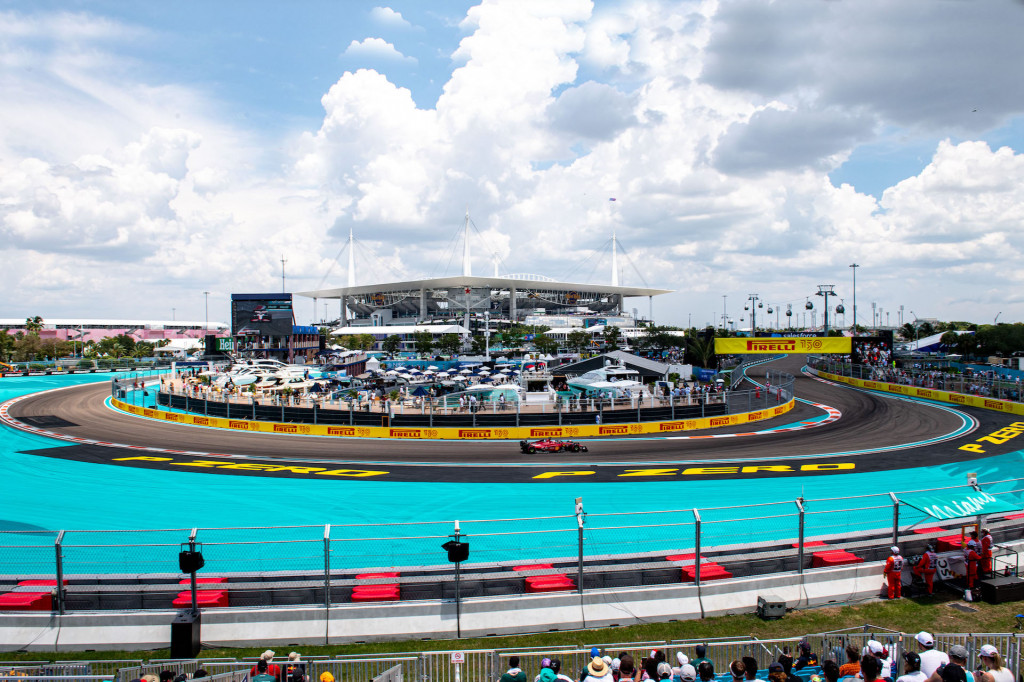
The view toward the Red Bull pavilion at the Miami Grand Prix track, with Hard Rock Stadium in the background. The sea of aqua-blue paint would prove magnetic for drivers attempting to pass.
Qualifying: Get this party started
So much was written before the race about the track itself, it’s already a part of F1 legend and lore. The race took place in Miami Gardens, not Miami proper, at Hard Rock Stadium (the old Joe Robbie) where the Dolphins play a dozen miles from the ocean, in a bumpy parking lot. The semi-temporary 3.36-mile circuit has a mock marina complete with boats stranded in synthetic water. It’s track design by mall developers, with enough aqua and coral paint to mildly irritate anyone who’s paid some $9,000 for a Miami Grand Prix ticket.
It’s conceived as a Disney confection, Tom Garfinkel, chief executive officer of the Dolphins, told Bloomberg: “It’s kind of like, ‘Do you want to go to Space Mountain? Do you want to go to Pirateland?’ ”
Me after paying $2,000 for a standing ticket #MiamiGP pic.twitter.com/wGQqhV5bQs
— Matt Amys (@mattamys) May 2, 2022
“This whole weekend is just full of firsts,” Megan explains. “Whoever gets on the pole today, that’s gonna be memorable. Whoever crosses the checkered flag first, that’s gonna be memorable.”
The Red Bull lounge hosts us, along with sponsor Acura (which takes over the Honda name on F1 cars next year). It boasts a sweeping view of a long straight and two slidey turns, racing simulators, a rooftop deck, and even a gelato station. There’s so much to take in, but so much that’s out of sight, around another corner, we watch much of practice on a massive screen hoisted in a Hard Rock Hotel paddock across the track. But from Red Bull’s pavilion we see Max and Sergio “Checo” Pérez roll by, and the hundreds of Red Bull guests erupt in applause and whistles and hoots.
“He’s the only one you cheer for, Verstappen,” I note.
She pauses. “I cheer for Checo,” she adds.
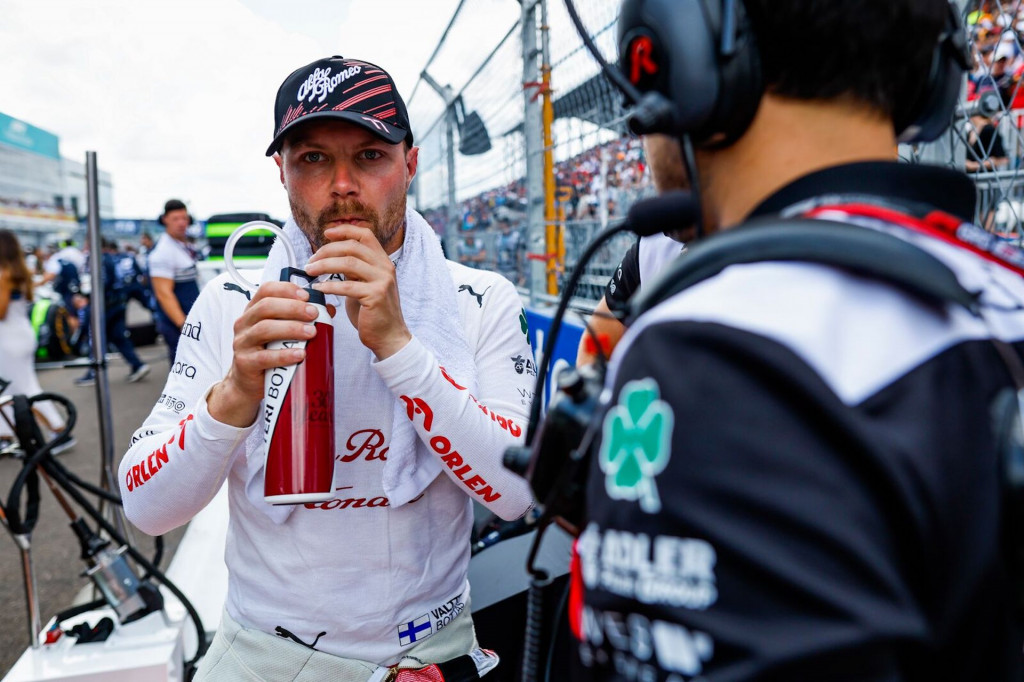
Valtteri Bottas stays hydrated during practice laps. He cracks up his #77 Alfa Romeo during the practice, but returns for day two’s practice and qualifying to slip into P5 for the Miami Grand Prix start.
Already drivers have complained about a bumpy track surface and the variation in surfaces from grippy track to skiddy run-offs, which makes the exact racing line the only safe place to drive. McLaren’s Lando Norris told Reuters that drivers expected the new Miami F1 track to be “very smooth and beautiful, but it’s not.”
Bottas goes off the track first in a sea of aqua blue, spinning backward into the barriers at Turn Seven, wrecking the car enough that it misses the rest of practice day, becoming the first red flag at the Miami track. Then Ferrari’s CarlosSainz crashes into Turn 14, sliding across the track into Heineken Field—what I call the slick paid advertising patch of green.
It’s already clear to me how the race might shake out—relatively few passes, fewer risks taken. Ricciardo’s McLaren confirms this by taking the tourist route around our corner while the AlphaTauri cars sizzle low and close to the curb; Yuki Tsunoda nearly gets jammed up in it, flying too low. Mercedes’ cars have aero issues, vividly on display as Russell porpoises and showers the corners with sparks.
I look away and return just as Verstappen slows down in mid-corner and his radio calls for “box, box, box”—and almost gets nailed by other cars.
“Why’s he going in?” I ask.
“His brake’s on fire,” Megan says without blinking.
“How do you know that?” I’m full of dumb questions.
“Because it’s on fire,” she points out, as flames spurt from the Red Bull car’s wheel on the jumbo screen.
The circus is so multidimensional and so spread out over the media universe, it pays to watch from your phone while you watch from the stands. Until Sebastian Vettel spins and almost gets pierced in front of the Porta-Potty sitting right in front of us, that is.
Qualifying: the clock’s ticking
Practice spans over a second day before it bleeds into qualifying, and when we settle in for a cool 92-degree peak on day two, Megan decides I can handle more. She explains that cost caps have evened the playing field—that it’s not just the Lewis Hamilton show anymore, that Ferrari is in the hunt again. New 18-inch wheels have led to less brake overheating and longer stints of wheel-to-wheel racing. She thinks the new aero designs will lead to less damage when cars get hit at the nose and on the wings over the front tires. She’s also talking about anime with Acura chief Jon Ikeda, as well as Verstappen’s brake problems. I think I’m bursting with pride, but it could be heatstroke.
She explains that during qualifying, tire choice becomes incredibly important. Each driver has a fixed number of tires to use for the whole race weekend, split between soft, medium, and hard. They might use as many soft tires as possible, but those could be too soft for the full race because of heat.
Then on to the Q1 explainer. Twenty cars go out for the fastest possible lap, then the five slowest get cut. Esteban Ocon cracked his car in half during the third practice, so only 19 drivers press through Miami’s tricky kinks, with the Red Bull and Ferrari cars swapping in and out of the top slots while Hamilton lurked just behind, with Alonso, Stroll, and Tsunoda leading Russell and Ricciardo. Rounding out the top 15 were Schumacher, Vettel, Norris, Gasly, and Alfa Romeo’s Bottas, the last of which drove the piss out of his mid-pack car just to learn the track after spending most of the first day’s practice sessions having his car rebuilt. Magnussen, Zhou, Albon, and Latifi drop out.
After a short break, the Q2 session goes through the same elimination with the remaining 15 cars. The top four continue to trade off spots, while Mick Schumacher pulls into the fray while Russell’s car visibly porpoises even more, throwing sparks. Schumacher drops while Norris rises into the top three—and Bottas surges into sixth, ahead of Hamilton while Russell languishes and Stroll stays in for Q3 along with Tsunoda and Gasly. On the outs: Alonso, Russell, Vettel, Ricciardo, and Mick Schumacher.
Q3, Megan says, is a top-ten shootout, all about strategery: the stickiest tires, the lightest load of fuel to get to P1—pole position, just like the Atari game I sucked at as a teenager. From the start, Verstappen and Leclerc switch off and on, with Sainz and Perez just behind, as they roll into flying laps. Leclerc sets a lap time of 1:28.796 seconds and takes pole position, while frustrated Verstappen checks in at P3, behind Sainz.
Collective “phew” in the Red Bull garage! 😲#MiamiGP #F1 pic.twitter.com/zUKTp00H0D
— Formula 1 (@F1) May 7, 2022
It’s all good, Megan says. “While being a hot head, Max is young,” she waxes, “and people forget Lewis was like that as well.” That said, it’s only moments until Verstappen overcooks the corkscrewy chicane that’s already seen a couple of incidents. He almost bites it in practice, but saves the car. Later, he calls his day “incredibly messy,” while team chief Christan Horner predicts a Red Bull-Ferrari battle in Miami for the first Grand Prix title.
Bottas comes in low and straight across the curb on final Q3 laps, surging to fifth place in the Alfa Romeo with the Ferrari engine. Megan’s Red Bull because of the Red Bull drinks; I figure I’m Team Bottas because of his consistency, persistence, and his Finnish reserve, emotional range is very important to me. Which of us will be happy come Sunday evening?
“What’s your ideal outcome?” I ask. She wants a 1-2 finish for Red Bull—and a DNF for Sainz. That’s hardcore. We’re so far beyond her first day at Catholic school, the years make my head spin. This time I know it’s not heatstroke.

Ferrari crew members get ready for the three-second tire-swap drill. Despite their valiant efforts, Ferrari driver Charles Leclerc (“L’Eclair” is one tasty nickname) finishes second, in front of teammate Carlos Sainz.
Race day: The Red Bull-Ferrari show
I am disturbing race day tradition. Megan and Dan make Sunday races a celebration, down to what’s on their plate. She recalls going to a diner before a Belgian Grand Prix where waffles seemed like the perfect call, given Max’s home country (he’s Dutch, but Belgian by birth). Now it’s a given they will research breakfast in the home country for each race and find new neighbors in the process. For one Middle Eastern race, it’s sweet vermicelli noodles with saffron and egg; for Texas, a feast of bacon, barbecue, and onion ring burgers; with Italy, a charcuterie spread; for the recent Australia race, cookies and biscuits and candies from Amazon like the violet crumble (“it’s the shatter that matters”).
Today Red Bull’s passing out unlimited cans of their signature drinks and crafting the best green-chile tacos I’ve had in years. It’s almost distracting enough, until at 12:49 p.m., it rains just enough to loosen the tire dust and oil on the track. The heat comes right back when the clouds lift, but the question lingers: is the track going to dry out before race time? It does, just in time, as the cars launch off the line and a deep rumble of shouts erupts from the crowd. Within seconds, Verstappen slips into second place with ease and the Red Bull crowd roars with approval.
Within a lap it’s clear that times are off the usual way, cars with heavier fuel loads are running five seconds slower. What’s not clear is how Hamilton can keep the pace: he passes Gasly easily, but draws no closer to Verstappen, who snips apexes tightly and takes first after a half-dozen laps. By then Bottas has stayed mostly invisible, but has lost no ground, still in fifth.
Max is opening up a wider gap as cars start to pit and change to harder tires. Tsunoda comes in earlier than most, while Leclerc stays out though his tires are showing wear after just 22 minutes into the race. Bottas is losing tire faster than he’s losing fuel weight and Hamilton is encroaching, but hasn’t quite caught up yet—while Vettel lingers at the back of the pack, shuffling between the Williams cars ahead of Zhou in the last-place Alfa Romeo #24.

Mercedes’ duo of Lewis Hamilton and George Russell try repeatedly to break out of mid-pack, but succeed only in passing Bottas. They finish 5-6—with Russell surging ahead of Hamilton late in the race.
By the 40-minute mark, it’s plainly a Red Bull-Ferrari battle with Bottas and Hamilton keeping it interesting. Bottas has been unflagging in fifth position; for the moment he may be driving the most reliable Alfa ever on an American paved road. But Verstappen has opened a 4.5-second lead over Leclerc when the French driver pulls in for tires—and even when Max does the same, with a low two-second pit time, he and Checo bookend the Ferraris after all four drivers have executed their tire swaps.
At the middle of the race, when the announcer warns rain is just eight minutes away, just about all the cars are on hard tires. The Haas cars slide through Turn Eleven past Vettel’s Aston and lure in Norris’ McLaren for an expensive-looking traffic jam. Megan watches from the rail, hardly moving, when Max posts a fast lap—and Gasly and Norris clip wheels. Norris spins, his right rear wheel launches down the track, and at just past half the race, he’s done for.
The rain never appears, but a handful of drivers swap tires again without the standings. It’s still Red Bull and Ferrari, with a side story of Bottas vs. Mercedes, when the Red Bull pavilion starts passing out the Champagne with confident swagger. “It’s a ten-lap sprint to the checkered flag…ideally,” the announcer intones wryly.
In the final laps, Checo wants a pass but can’t get it. He gets a look twice, a third time—and can’t get it done. Bottas gets serious pressure from Hamilton and Russell, and both pass him. “Fuck,” I mutter. Impartiality is a process, not a place, I tell myself.
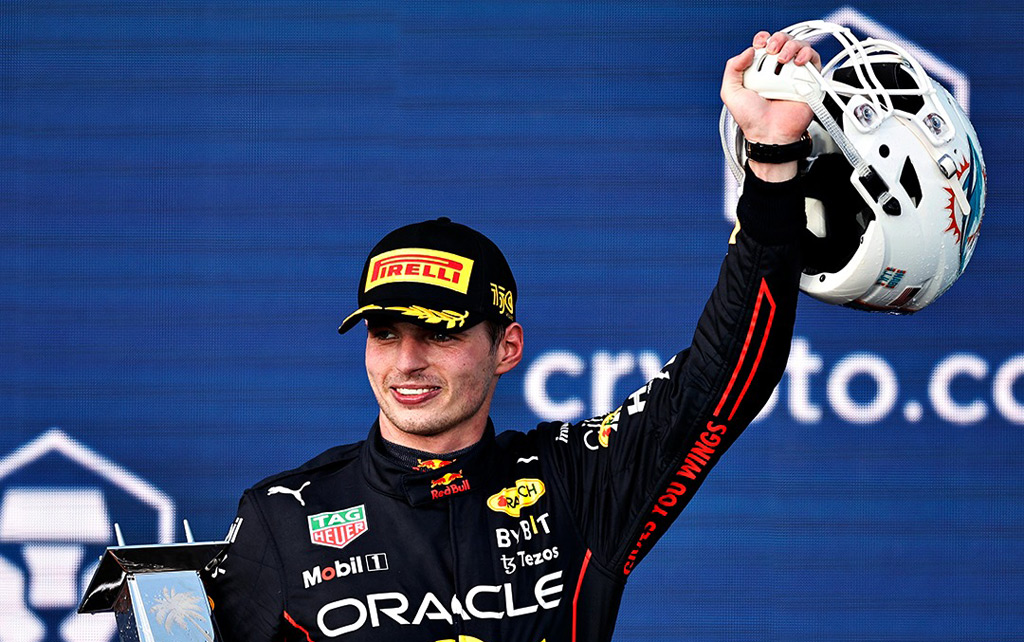
Red Bull Racing’s Max Verstappen at the 2022 Formula One Miami Grand Prix
Predictions of a bad off-line track, a bad show and bad passing have failed to come to pass. But the Miami Grand Prix doesn’t end without drama. With less than two laps to go, Vettel and Schumacher hit: “It was my corner, it was my corner,” Schumacher is overheard telling his mentor. “I’m so sorry!” Within moments, Russell has slingshotted ahead of Hamilton, but it’s not enough. Max cruises to the win, and Megan is ecstatic.
Bottas comes in seventh. What will it take to see him get into the top three—or even to P1?
Megan says I’ll need to start following more of everything to know why that’s not going to happen. She subscribes to the F1 app, which lets her watch races going back to the 1950s (“boring”) or watch Ricciardo’s ascendancy through lower tiers of racing.
She’s a Reddit fan, an F1 fantasy leaguer, and she also spins through Twitter on the day after a race, LOLing at the memes that flood the #MiamiGP hashtag. But for the real experience, she offers, “you’ve really gotta commit to waking up on Sundays or to watching the app when you can.”
Like me before Miami, Megan didn’t think she was qualified to fangirl over F1 at first. A peek at Twitter’s other Formula 1 hashtags gives good reason: like much of social media, it’s a hothouse of grievances and sexism, fired up with the intensity of a thousand suns.
“There is a lot of gatekeeping on the Internet,” she agrees, “especially from longtime Formula 1 fans—not just Europeans, but even Americans who have been into it for most of their life. They feel like, oh, Netflix came out with a show and now people are into it.”
We talk about the social cost of racing beyond individuals, too. The series exacts other penalties on the communities that host it. Miami Gardens residents protested Formula 1’s arrival in their neighborhood: Betty Ferguson told Jalopnik that “We feel like they steamrolled over our legal rights because we were perceived as a powerless black community.” The race was moved from the initial planned site downtown to the stadium area around Miami Gardens, where some70% of residents are Black. If you can’t afford the $9,000 ticket, F1 can easily be viewed as a high-carbon-footprint boondoggle, equal parts Watkins Glen and Monaco but also Detroit and Sochi.

The complex questions behind the series haven’t cost it fans, yet. But will “Drive to Survive”do that—can Formula 1 become too popular? Can it oversaturate America, which gets a third race in Las Vegas for the 2023 season?
“You have people saying that’s too many races in America,” Megan says. “Well, America’s a big place.” To her, Formula 1 has a long way to go before it becomes overkill. “It’s the only thing that has been able to consistently wake me up on Sundays in my life.”
It’s not that yet for me and I can almost guarantee it won’t ever be that. But I’ve been remiss in not understanding it better, or appreciating the drama that follows it. F1 is an extension of the global footprint of the auto industry where I make my living, for sure—and now it’s a new connection, an unexpected one. It turns out I’m not half-bad at seeing something in a whole new light. Someone, too.
Acura hosted Motor Authority at the Miami Grand Prix so we could bring you this story.