You may not think much about that little sticker affixed to a corner of your license plate or the inside of your windshield, but it signifies an achievement for your clean-running car: passing your area’s emissions test.
It’s an annual event for many car owners across the U.S. that involves a trip to a privately run garage or a sprawling government facility. Except that for just as many of us, smog testing is a totally foreign concept, thanks to the convoluted patchwork of air-quality regulations across the U.S.
Here’s what you need to know about emission testing, whether or not you’re subject to it
In some—but not all—of America’s most populous metropolitan areas, an annual or biennial emissions test is federally mandated. Each metropolitan area can choose how to implement testing, and the results vary considerably.
Some require a check-up at a state-run testing station, while others ask drivers to visit licensed garages less often.
Though the end goal for this crazy quilt of legislation is the same everywhere—cleaner air via lower emissions of carbon monoxide, carbon dioxide, hydrocarbons, and oxides of nitrogen—its implementation is far from consistent.
It all dates back to amendments to the Clean Air Act passed in 1970, which gave the federal government the power to regulate what could legally be emitted from a new vehicle’s tailpipe. Previously, federal motor vehicle regulation was limited primarily to safety standards. Automakers raised red flags over their concerns about the cost and challenges of cleaning up emissions, but ultimately the Clean Air Act has worked well to do exactly what its name implies.
In 1990, the EPA created National Ambient Air Quality Standards (NAAQS) that required the nation’s dirtiest cities to clean up what their citizens breathed. Idling cars are among the biggest polluters, so the EPA requires states to measure what comes out of tailpipes at idle.
Each state enforces NAAQS somewhat individually, though the EPA has ultimate approval of the testing techniques required. Some states require testing for all cars. Others exempt vehicles 20 or 30 years old, or those with certain license-plate types.
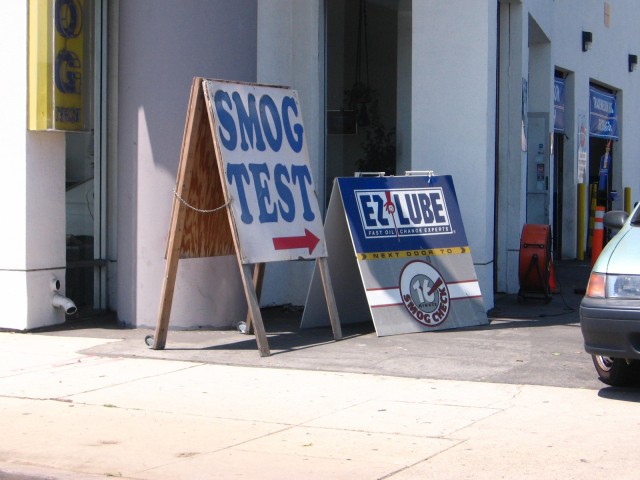
Smog test, California, courtesy Flickr user viewfrom52
Enlarge Photo
Most don’t have statewide testing, instead reserving it to metro areas with lower air qualities. For instance, an Indiana vehicle registered near Chicago is required to be tested every other year while one registered in Indianapolis never has to be tested. The EPA determined that the air quality in the Chicago area is poor enough to require biennial testing, but that the air in Indianapolis is clean enough as is.
How each state handles emissions testing costs also varies wildly. States like Illinois and Wisconsin don’t charge fees for an emissions test. Others, like New York and Texas, bundle emissions testing into an annual safety inspection.