
Audi on Thursday provided an early glimpse of some of the technology that might give upcoming premium electric vehicles from the brand—beyond the current E-Tron SUV and Sportback—an edge in terms of comfort, performance, and perhaps efficiency.
Just as well-timed power delivery and torque distribution can help a vehicle corner better, having a suspension system’s reaction tuned and timed just right to strong acceleration and braking—and vice versa—is all part of the potential as vehicle controls move to a fully connected, digital reality.
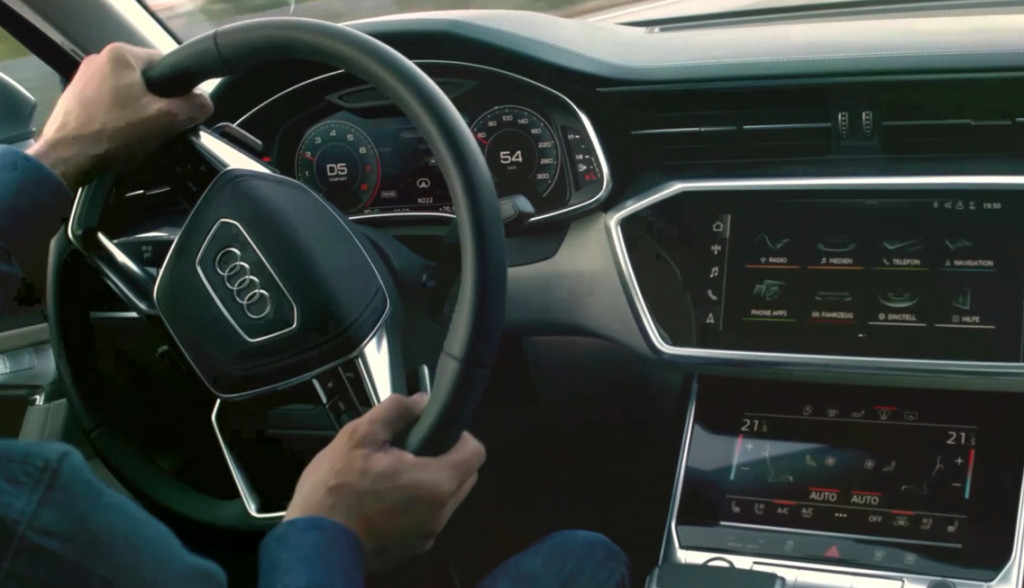
Audi steering and suspension
But in order to actually get the timing right, these systems can’t continue relying on different, independent controllers. Audi outlined in a virtual presentation earlier this week, it’s planning to level up its Electronic Chassis Platform (ECP) that’s used in the E-Tron SUV and Sportback, among other models, by adding acceleration and regenerative braking to the mix.
According to Audi officials, the next-generation version of the ECP will have about ten times the computing power of the current unit in the E-Tron. It takes “a holistic approach” by adding that new dimension and coordinating propulsion with handling, braking, safety systems, and more.
In all, the upcoming system can simultaneously actuate up to 90 components, versus a maximum of 20-24 in its present form. Separate check-and-balance processing units would gauge the signals coming from the central computer’s algorithms versus independent thresholds for each system.

Audi central vehicle dynamics computer – presented August 2020
Another strength of the system will also be that the computer is flexible in how it’s installed and Audi can flexibly apply the same unit across all of its vehicles and systems—regardless of front- or all-wheel drive, gasoline, hybrid, or electric. Versus the current system, the new computer will offer the potential for over-the-air updates, and is ready for V2I technology as it arrives.
Audi said that it serves to gain the most from the system with vehicles that are heavy, those with taller centers of mass, and EVs, and so the E-Tron checks all the boxes. “Ultimately, we will even be able to increase the efficiency of the powertrain in the process,” said Klaus Diepold, who is responsible for chassis-development network architecture.
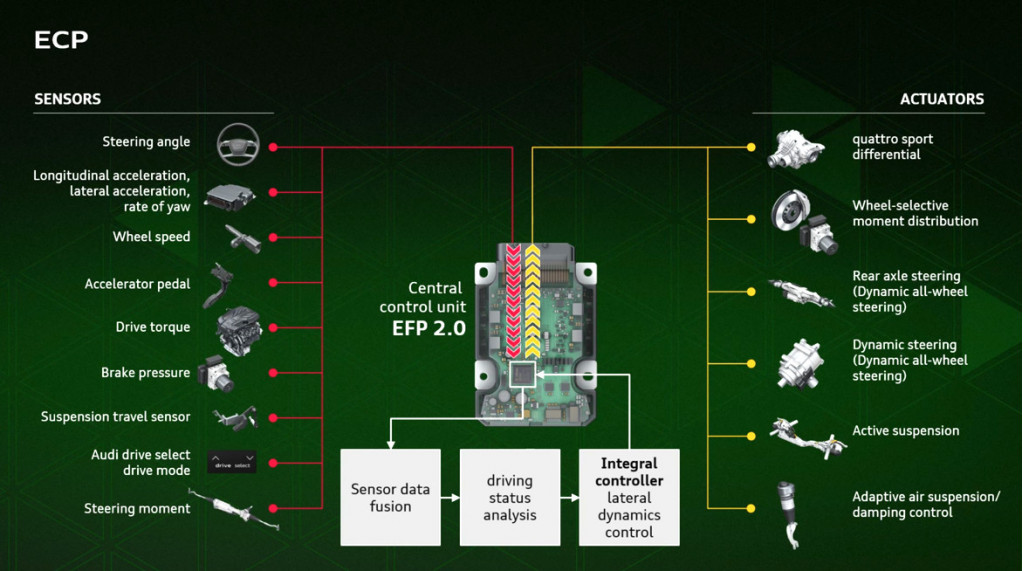
Audi central vehicle dynamics computer
The E-Tron can already recover up to 0.3g through the electric motors—producing up to 220 kw—without at all engaging the brake pads. Audi says that it applies to 90% of all deceleration events.
It accomplishes its brake-blending through a world-first electro-hydraulically actuated system that doesn’t use a mechanical linkage from the brake pedal—allowing a faster response time for maximum brake pressure of just 150 mm. The braking system already has another advantage over those of other EVs; it can opt to use recuperation on one axle while the pads are applied on the other—whatever yields the more energy back.
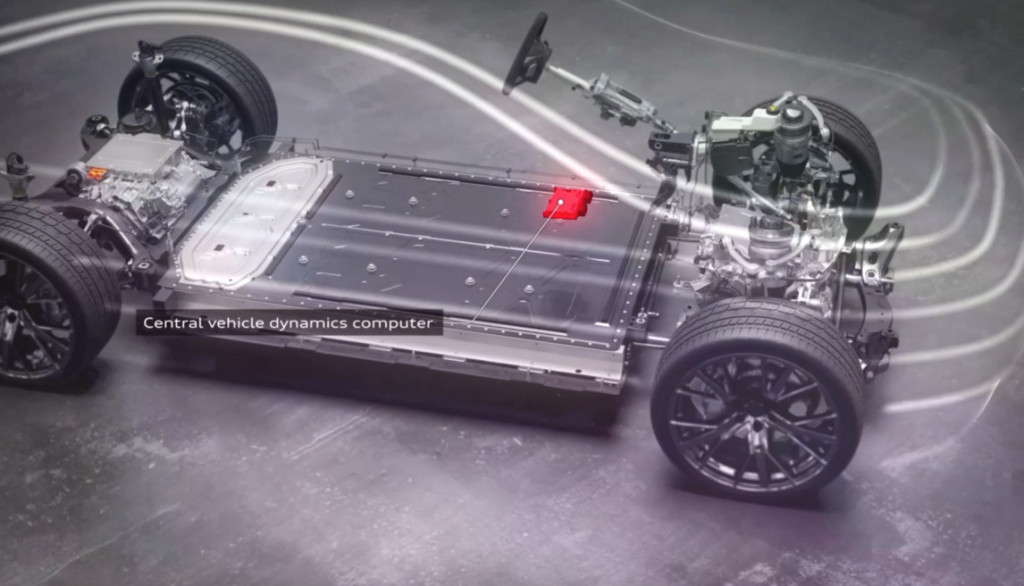
Audi central vehicle dynamics computer
With the new brains controlling these behaviors, as they relate to things ranging from body control to steering response to dampers, getting all these components working as a team should pay dividends.
Audi wouldn’t yet say which upcoming products it might be putting this vastly upgraded, smarter system into. But for a new generation of Audi’s large sedans and SUVs, a revamped E-Tron, or an electric flagship from the brand’s Project Artemis, well we’d bet on all of the above.


